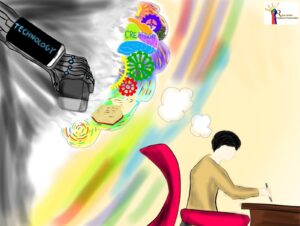
AI can’t replicate humans, but they have power to create machine mind
“The danger does not begin when we get help. The danger begins when we stop thinking” – by Sneh Kataria
From Human Thinking to Machine Commanding
Earlier, the natural human process looked like this:
- Think deeply
- Understand the situation
- Break down the problem
- Seek support if required
- Apply judgment and responsibility
Now, for many people, the process has quietly shifted to:
- Give a command
- Receive an output
- Assume the work is complete
This change may appear minor, but its long-term impact is serious. Humans begin trusting machine-generated responses more than their own reasoning. Over time, this leads to reduced confidence, weakened critical thinking, and increasing dependency.
AI does not force this shift. Humans choose convenience—and convenience, when it replaces consciousness, becomes a risk.
What the Data Is Quietly Telling Us
Multiple global surveys and studies conducted between 2022 and 2024 reveal worrying patterns in human behavior after widespread AI adoption:
- Over 55–60% of students in higher secondary and undergraduate education admit that they now rely on AI tools before attempting to solve problems on their own.
- Nearly 45% of professionals surveyed globally reported a decline in independent decision-making confidence after regular AI use.
- Around 40% of employees acknowledged that they often accept AI-generated suggestions without questioning feasibility or context.
- More than 65% of young users reported reduced patience for deep thinking and long problem-solving processes after frequent AI usage.
- Educators across multiple countries have observed a noticeable decline in originality, handwriting quality, and self-structured answers among students.
These numbers do not suggest that AI is harmful. They suggest that human thinking habits are changing—and not always in a healthy direction.
Doubting Ourselves in the Name of Friendship
AI is our friend, but sometimes in the name of friendship, we begin to doubt our own capability.
Just like in human relationships, when we rely too much on a friend, we stop trusting our own judgment. We start acting according to their thinking, their style, and their decisions. The same pattern is visible with AI.
Slowly, humans begin believing:
- “The machine knows better than me.”
- “Why think so much when the answer is ready?”
- “If AI says it, it must be right.”
This mindset creates a dangerous cycle:
- Less thinking → more dependency
- More dependency → less confidence
- Less confidence → blind following
This is how humans do not get replaced by machines—but slowly become machine-like themselves.
Real-Life Examples: Where the Problem Becomes Visible
Education
A student faces a difficult concept. Earlier, the student would struggle, ask questions, make mistakes, and finally understand. Today, many students directly ask AI for answers, essays, or explanations. The output looks perfect—but learning is missing.
Over time, the student starts believing:
“I cannot study or write without AI.”
The real loss here is not marks.
The real loss is thinking ability and self-belief.
Workplace
An employee faces a complex situation involving people, emotions, and real-world constraints. Instead of analyzing the situation, they depend fully on AI-generated solutions. When those solutions fail in reality—because real life cannot be fully predicted by data—confidence drops, and accountability weakens.
AI did not fail.
Human thinking was skipped.
Loss of Individuality and Creativity
Every human being has a unique way of thinking, working, and solving problems. That difference is our greatest strength. Machines operate on patterns; humans operate on experiences.
When humans blindly follow AI-generated styles, ideas, and structures:
- Language becomes similar
- Ideas become repetitive
- Creativity reduces
Not because AI destroys creativity—but because humans stop exercising it.
A society where everyone thinks alike may appear efficient, but it becomes fragile. Innovation requires difference. Progress requires questioning.
AI Cannot Replace Humans—but It Can Shape Them
AI does not feel emotions.
It does not understand social inequality, ethical dilemmas, or lived struggles.
It cannot replace empathy, moral responsibility, or wisdom.
But AI can shape how humans think—if humans allow it.
When humans stop questioning and start obeying machine logic, machine minds are created—not inside machines, but inside people.
The Future: Fast or Thoughtful?
AI is undoubtedly part of the future. But the real question is not whether AI will grow.
The real question is:
Will humans continue to think?
A future without thinking may be fast—but shallow.
Efficient—but emotionally disconnected.
Automated—but ethically weak.
Thinking should never stop.
Progress without thinking is not progress—it is automation without wisdom.
The Solution: Change the Process, Not the Tool
The solution is not to reject AI.
The solution is to use it consciously.
A healthy human-centered process is:
- Think first
- Understand the real problem
- Define requirements clearly
- Use AI as a support tool
- Apply human judgment and values
AI should come after thinking—not before it.
An NGO and Social Development Perspective
From a social sector perspective, this issue is critical. Communities already facing inequality, limited access, and lack of confidence cannot afford to lose their thinking power.
Empowerment begins with awareness and self-belief—not blind technological dependence.
Technology should strengthen humans, not replace their judgment.
Social change is driven by thinking humans, not intelligent machines.
Conclusion: Stay Human in an AI World
Is AI the problem? No.
But hidden inside the solution is a problem—if humans stop thinking.
AI is our friend.
But a friend should make us stronger, not dependent.
AI cannot replicate humans—but it has the power to create machine minds if we allow it.
The future must belong to thinking humans who use AI wisely, not humans who stop thinking because of it.